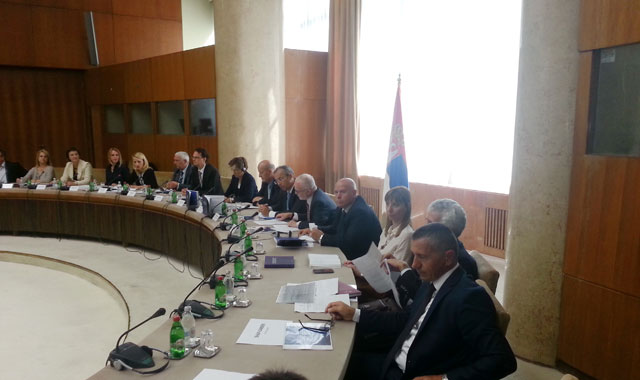
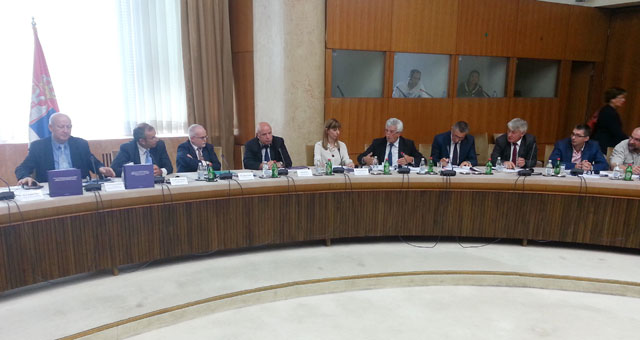
According to a study on the possibilities of improving the teaching and learning of Serbian as a second language in the elementary schools of the municipalities of Presevo, Bujanovac and Medvedja , which was presented at the meeting held in the Palace of Serbia, only five percent of the Albanian students from the said three municipalities, who learn Serbian as a second language, have the knowledge of Serbian and the functional ability for effective oral and written communication.
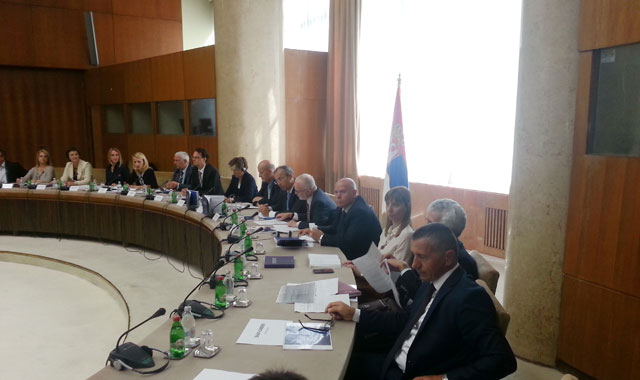
According to a study on the possibilities of improving the teaching and learning of Serbian as a second language in the elementary schools of the municipalities of Presevo, Bujanovac and Medvedja , which was presented at the meeting held in the Palace of Serbia, only five percent of the Albanian students from the said three municipalities, who learn Serbian as a second language, have the knowledge of Serbian and the functional ability for effective oral and written communication. As noted, the unsatisfactory level of knowledge of the official language is brought into direct contact with significantly reduced chances for the Albanian minority to use the opportunities related to their education, applying for employment and being more involved in the decision-making process.
Milica Rodic, the Advisor to the Director of the Coordination Body and project coordinator, explained that the study was done from February to July of the year and that it included 16 primary schools in the three municipalities of South Serbia, as well as that it was carried out among students from the fourth to the eighth grade. In addition to students, teachers and school principals were interviewed, too.
“The knowledge of five per cent shows that the students acquired the knowledge outside the school, while the causes of poor knowledge of the Serbian language are manifold and lie primarily in the fact that students are rarely in contact with their peers whose native language is Serbian, while many of them lack proper textbooks”, said Ms. Rodic. She added that in addition to that, there is a lack of trained teachers, who are for various reasons deficient, and to whom the appropriate training and professional development are often unavailable.
The Minister of Education, Science and Technological Development, Srdjan Verbić, said that the drafting of the study was a precedent that proved that we had matured as a society or that we were approaching maturity.
“The reasons for doing the study aren’t political, but they are economic ones. We are starting work on a large project that we want to solve for economic reasons,” Minister Verbic said.
He underlined the Ministry’s firm and clear commitment to do everything in conformity with the Council of Europe’s Convention for the Protection of National Minorities and agreed that it would operate in accordance with what had been outlined in the Strategy for the Development of Education. He stated that there were many education-related things that needed correction, reform and improvement, that higher education was one of the things of very good quality and that higher education should be available to everyone.
“Our interest is that all of our people should study at our universities, which are better than universities in the region. We do not want anyone to go to other countries due to language if there is a better university that's closer to them”, Minister Verbic said.
Zoran Stankovic, the President of the Coordinating Body for the Municipalities of Presevo , Bujanovac and Medvedja , said that the results of study were very important and that it was necessary for all state agencies, local self-governments and interested donors to do everything to provide the resources for the implementation of the recommendations of the Study.
The Head of the EU Delegation to Serbia, Michael Davenport, said that the Serbian legislation contained very commendable provisions aimed at improving the protection of the rights of national minorities, adding that they improved in recent years. However, he said that it was clear that the use of those laws and regulations in practice wasn’t always satisfactory.
“Speaking of integration, education plays a significant role in the creation of identity in multi-ethnic societies and is an important instrument”, said Mr. Davenport.
Speaking of the situation in the southern part of the country, Mr. Davenport pointed out that there were a number of obstacles, such as lack of adequate textbooks in Albanian.
“Serbian authorities should boost its efforts to ensure the availability of textbooks in minority languages in a way that suits the needs of ethnic minorities”, said Mr. Davenport.
The British Ambassador to Serbia, Denis Cliff, said that the embassy was devoted to integrating minorities into society and the respect for minority rights, and that the two processes should be implemented in parallel. He pointed out that it was good that young Albanians were interested in learning the Serbian language and added that the issue should be addressed by the governmental institutions.
Nagip Arifi, the mayor of Bujanovac, said that the Albanians in South Serbia could speak Serbian far better twenty years before than they currently did, since “Serbian had become the language of hate speech against Albanians” since 1999. According to him, a course in the Albanian language was organized in Bujanovac the year before and a great many Serbian secondary-school students were interested in it.
“The school year in Bujanovac , Presevo and Medvedja won’t begin on September 1 because there are no textbooks in Albanian. I support learning Serbian, but minorities should also be provided with the conditions for starting the school year”, Mr. Arifi said. He said that employment in state bodies should be in accordance with the ethnic composition of the population and added that some state bodies in the three municipalities were “ethnically pure”, because only Serbs were employed there. The situation was the same is in some public enterprises, too, said Mr. Arifi.
Source: Coordination Body, Beta News Agency, Serbian Broadcasting Corporation, Tanjug News Agency, Radio Beograd 1