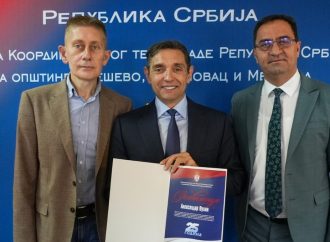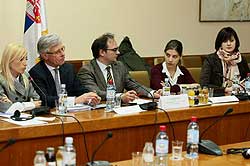
BELGRADE – The Coordination Body of the Government of the Republic of Serbia for the Municipalities of Presevo, Bujanovac and Medvedja and the Ministry of Education, in cooperation with the Center for Non-Violent Resistance and the Center for Educational Policies, held a discussion on preliminary results and conclusions of the Feasibility Study for the Opening of Institutions of Higher Learning in Presevo and Bujanovac at the Palace of Serbia on March 3, 2010.
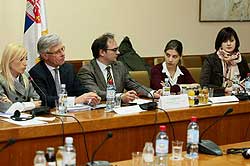 BELGRADE – The Coordination Body of the Government of the Republic of Serbia for the Municipalities of Presevo, Bujanovac and Medvedja and the Ministry of Education, in cooperation with the Center for Non-Violent Resistance and the Center for Educational Policies, held a discussion on preliminary results and conclusions of the Feasibility Study for the Opening of Institutions of Higher Learning in Presevo and Bujanovac at the Palace of Serbia on March 3, 2010. The discussion was opened by the speeches of Nenad Djurdjevic, Director of the Coordination Body, Ambassador Knut Volleback, OSCE High Commissioner on National Minorities and Tinde Kovac Cerovic, State Secretary at the Ministry of Education of the Serbian Government. The conclusions of the Feasibility Study were presented by Jana Bacevic, PhD, the research team leader.
Nenad Djurdjevic, Director of the Coordination Body’s Office, announced in his introductory speech the establishment of the Working Group that would be dealing with development of university education in Presevo and Bujanovac. “This working group will be jointly set up by the Coordination Body, the Ministry of Education, the OSCE representatives and the academic and local community, in accordance with the Feasibility Study for the Opening of Institutions of Higher Learning in Presevo and Bujanovac”, Mr. Djurdjevic said and added that “development of university education in Presevo and Bujanovac was motivated not only by the need to make university education in mother tongue available to the Albanian community, but also by a desire to contribute to the economic development of this poor region by raising the general level of education of the population.”
The Feasibility Study, whose final text will be completed and presented this April, envisages that university education in Presevo and Bujanovac should develop within the institutional framework of the Republic of Serbia, if possible within the framework of the existing institutions of higher learning in Nis, Kragujevac and Novi Pazar. As Nenad Djurdjevic underscored, “the development of university education must be sustainable, while the future study programs in Serbian, Albanian and, ideally in Romany, should meet the needs of labor market and enable the launching of economic development.” One of preliminary conclusions of the Feasibility Study, which is a key statement, envisages the development of additional activities, so that joint socialization and communication among members of different communities would be made possible, said Director of the Coordination Body’s Office.
Tinde Kovac Cerovic, State Secretary at the Ministry of Education, said that the issue of establishing the system of university education in South Serbia was the priority of the Ministry of Education, which got engaged in this project a year ago by working on the project of opening the extended departments of the Nis University’s Faculties of Law and Economics in Medvedja. The State Secretary pointed out that the Ministry of Education was pursuing a new educational policy, which relied on the following three goals: increased employment, providing appropriate education to all ethnic groups and the quality of innovation – the foundation of offering new knowledge and skills. She also said that the goal of the Ministry of Education was to use all elements of the social context in practice, and added that the Ministry of Education was willing to continue being engaged in implementation of this project.
Ambassador Knut Vollebaek, OSCE High Commissioner on National Minorities, underlined that education in South Serbia should be multiethnic and multilingual, and estimated that it was of key importance for development of the entire South Serbia. Mr. Vollebaek pointed out that education was a way to make the future better, and said that institutions of higher learning in Presevo and Bujanovac would make it possible for Serbs, Albanians and Roma to study in their mother tongues, which will facilitate the integration of these three ethnic communities. Ambassador Vollebaek also said that it was important for all sides to be involved in the project, including representatives of three local self-governments, because the project was implemented for the benefit of all the population of South Serbia. “The OSCE High Commissioner on National Minorities is going to provide full support to the implementation of the remaining portion of the project,” said Knut Vollebaek.
In a discussion in which Presidents of the Municipalities of Presevo, Bujanovac and Medvedja, Ragmi Mustafa, Saip Kamberi and Slobodan Draskovic, took part, as well as MP Riza Halimi, Presidents of the Municipal Assemblies of Presevo and Bujanovac, Skender Destani and Jonuz Musliju, and a member of the Bujanovac Municipal Assembly, Stojanca Arsic, PhD, constructive remarks on some of the conclusions of the Study were made, but most of them thought that the Study was a step made in the right direction. They also believed that local partners were willing to get involved in the Working Group, which is the next phase in the implementation of the project.
The Feasibility Study is a result of the “Reform of the Educational Policy in South Serbia” project, which is aimed at systematizing the elements of the educational system in Serbia, perceiving the comparative experiences from the region and offering possible scenarios for future activities.
The Study was financially supported by the Fund for an Open Society, the UK Department for International Development, and the Balkan Trust for Democracy and the Coordination Body of the Government of the Republic of Serbia for the Municipalities of Presevo, Bujanovac and Medvedja.